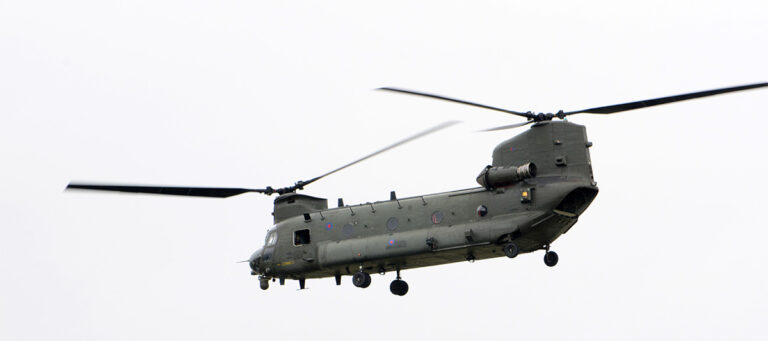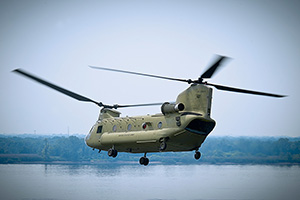
Flying Boeing CH-47 Chinook Helicopter

10 Facts about the Boeing CH-47 Chinook

Here are 10 key facts about the Boeing CH-47 Chinook heavy-lift helicopter:

  1. The Chinook is an American twin-engine, tandem-rotor heavy-lift helicopter developed by Vertol and manufactured by Boeing.[1][2]
  2. It is among the heaviest lifting Western helicopters, with a maximum lift capacity of 26,000 pounds (11,800 kg) at sea level.[1][4]
  3. The Chinook’s name comes from the Native American Chinook people of Washington state.[1]
  4. The Chinook was originally designed to replace the Sikorsky CH-37 Mojave helicopter, which was retired from the U.S. Army’s fleet in the late 1960s.[3]
  5. The Chinook first flew in 1961 and entered service with the U.S. Army in 1962.[1][3]
  6. The Chinook has been used in a variety of military and civilian roles, including cargo transport, medical evacuation, search and rescue, and disaster relief.[1][3][5]
  7. The Chinook is powered by two Honeywell T55 turboshaft engines, which provide a combined 10,138 horsepower.[3]
  8. The Chinook has a maximum speed of 315 km/h (196 mph), making it the world’s fastest military helicopter.[3]
  9. Over 1,000 Chinooks have been delivered to militaries around the world, including the U.S., UK, Australia, Egypt, and others.[5]
  10. The Chinook is considered the “workhorse” of the U.S. Army helicopter fleet and has seen extensive use in conflicts such as the Vietnam War and the wars in Afghanistan and Iraq.[3][4]

Citations:
[1] https://squadronnostalgia.com/shop/aircraft-models/helo-aircraft-model/ch-47-chinook/
[2] https://www.scalemates.com/topics/topic.php?id=777
[3] https://aerospace.honeywell.com/us/en/about-us/blogs/33-things-you-probably-do-not-know-about-chinook-ch47
[4] https://billingsflyingservice.com/ultimate-heavy-lift-helicopter/
[5] https://www.rafmuseum.org.uk/blog/the-boeing-chinook/

Similar Posts

  • Medevac Helicopters in the Middle East

    Helicopters have proven themselves time and again in every scenario they have been exposed to. One of the areas they have particular excelled at is medevac and casevac.  Helicopters can and will go where other aircraft cannot and where ambulances can’t reach to rescue the wounded. They provide fast, smooth transportation of casualties to field hospitals many miles from the front lines and offer the ability to begin critical care as soon as they enter the airframe.

    During the two Iraq wars and while in Afghanistan, helicopters have continued their service to troops on the front lines. Soldiers and commanders depend on them, they regard them as essential and combat operations are not planned unless medevac choppers are available if needed. Such is the importance place on them in modern warfare.

  • Modern Military Helicopters Have To Fly Faster

    Since the military started using helicopters at the end of World War II, the performance of the helicopters has not seen great increases. The major changes to existing military helicopters have been on the ‘inside’ with better communications, advanced weapon capability and durability. Today’s military relies on the Apache and Black Hawk helicopters that are expected to remain in service until the late 2030s. The Apache helicopter has been in service since 1986, the Black Hawk since 1979, and even the smaller Kiowa helicopter has been in service since 1966.

  • |

    The Huey Helicopter’s Role in the Final Chapters of Vietnam

    As the Vietnam War neared its end, the Bell UH-1 “Huey” played an instrumental role in shaping its final chapters. From aiding the US’s drawdown strategy to facilitating desperate evacuations during Saigon’s fall, the Huey was at the conflict’s heart. Yet, its legacy extends beyond combat. Post-war, even as a divided nation sought to heal, the Huey found new life in reconstruction and unification efforts. Dive into the intertwined destinies of a nation and an aircraft and explore how the Huey transformed modern warfare.

  • Introduction to the Iconic Sikorsky UH-60 Black Hawk Helicopter

    The U.S. Army identified the need for a Utility Tactical Transport Aircraft System (UTTAS). They aimed at replacing the UH-1 Iroquois. For this purpose, the Sikorsky Model S-60 came into the picture. The first flight of the prototype took place on October 17, 1974. The Army intended to order 2,260 units of what became the UH-60 Black Hawk. However, budget limitations led to reducing the order down to 1,400 units. The first Black Hawk entered service in June 1979.

  • |

    The Bell UH-1 Huey Helicopter

    In 1952 the US Army specified a requirement for new helicopter to serve as a medical evacuation, helicopter trainer, troop transport and general utility helicopter. Of the twenty companies that submitted designs, Bell Helicopter won the bid in late 1953 to build the first 3 prototypes based on their Model 204 design. The first flight of the XH-40 was October 20th, 1956 at Fort Worth, Texas and Bell was commissioned to build the first 100 HU-1A helicopters in March 1960, officially named Iroquois. While its official name is rarely used, the helicopter was nicknamed the Huey and the name stuck even after the US Army changed its designation to UH-1 “Huey” Helicopter.

  • CH-46 Sea Knight Helicopter – Workhorse of the Navy

    The CH-46 Sea Knight Helicopter has been the workhorse of the Navy and Marine Corps medium-lift squadrons since it entered service in June 1964.  It was developed as the Vertol Model 107, which was also being designed for the civilian market, and was first flown on April 22, 1958.  An initial trial batch was ordered by the Army but this was redued when Vertol published drawings of the enlarged Model 114 which became the Chinook.  By 1960 Vertol had been absorbed into Boeing.