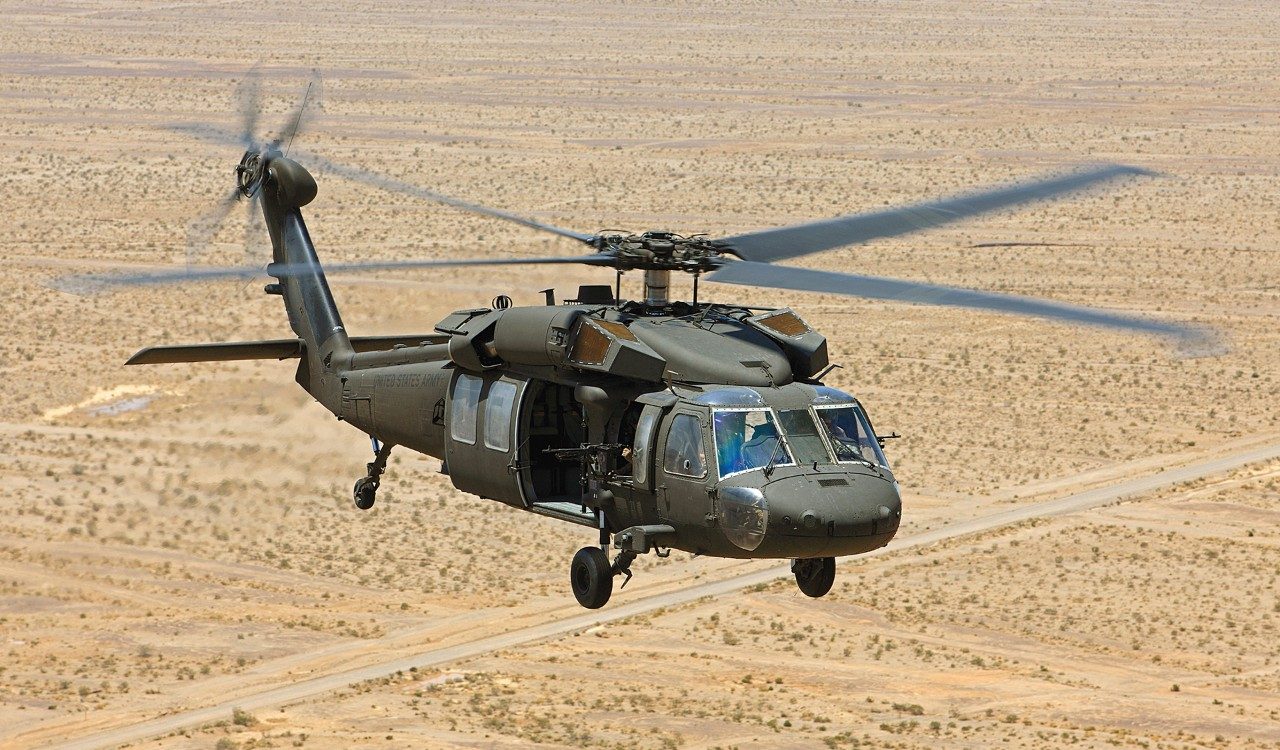
Sikorsky UH-60 Black Hawk Helicopter

Masterpiece of Military Aviation: The Sikorsky UH-60 Black Hawk Helicopter

Welcome to a comprehensive journey of understanding the Sikorsky UH-60 Black Hawk helicopter. In this article, we will explore its inception, its various models, and the distinct roles it plays in the military. Prepare to unlock the rich history and extensive capabilities of this groundbreaking aircraft.

A Tactical Revolution: The UH-60 Black Hawk

The genesis of the UH-60 Black Hawk began with the Sikorsky Model S-60, engineered to replace the UH-1 Iroquois. The Army’s demand for an advanced Utility Tactical Transport Aircraft System (UTTAS) spurred its creation. The inaugural flight took place on October 17, 1974. The Army ordered a whopping 2,260 Black Hawks. However, budget restrictions brought the order down to 1,400 units, with the first one becoming operational in June 1979.

Compared to the UH-1, the Black Hawk presents a larger build, accommodating twenty troops compared to eleven and bearing an underslung load of 8,000lbs. The UH-60 is also highly portable. A C-130 Hercules can transport a single UH-60, while a C-141 StarLifter fits two, and a colossal C-5 Galaxy can carry six.

An Illustrated History of Military Helicopters

An Illustrated History of Military Helicopters

A complete history of Army and Navy helicopters from the first visionaries to unmanned aircraft systems. This book, with over 200 helicopter photographs documents every generation of rotorcraft from early prototypes to the specialist helicopters of today.

Amazing text. As a Veteran helicopter mechanic I am passionate about all birds and their histories. Highly recommend this book. It sits firmly on my coffee table to spread the allure to friends and visitors alike. – John J.

Evolution of the Black Hawk

The initial Sikorsky UH-60A model gave way to the more robust UH-60L, which boasts stronger engines and a reinforced underslung hook. The Medevac variants of both models can host six stretchers. The military upgraded around 40 UH-60Ls to EH-60As to enhance battlefield electronic warfare capabilities. Another thirty received modifications to become MH-60As for special operations. The first flight of the UH-60M prototype took place in September 2003 and is expected to take over the role of the UH-60L.

Pave Hawk and Special Operations Forces Black Hawk

The UH-60A was also the blueprint for the Air Force’s HH-60G Pave Hawk, used for Combat Search and Rescue (CSAR). A C-130 Hercules can refuel this model, and operators can equip it with pintle-mounted machine guns for hostile terrain. Drawing inspiration from the Special Operations Forces MH-60K Black Hawk, the MH-60L underwent a substantial upgrade with additional weaponry.

Presidential Flight and Marine Corps Involvement

The Presidential Flight took possession of the first of nine VH-60N White Hawks in November 1988, operated by the Marine Corps. However, the Marine Corps declined to accept the proposed H-60E.

Navy Involvement: Seahawk to Knight Hawk

The S-60B became the SH-60B Seahawk after winning the Navy LAMPS MK.III competition in 1977. Sporting automatic tail and rotor folding, it serves Anti-Submarine Warfare (ASW) and Anti-Ship Missile Defense (ASMD) roles. The SH-60F Ocean Hawk succeeded the SH-3D Sea King. Moreover, with its larger cabin volume, the MH-60S Knight Hawk is poised to take over the Fleet Combat Support Aircraft role from the HH-46s.

The journey of the Sikorsky UH-60 Black Hawk is a testament to the evolution of military aircraft. From its original design to its latest incarnation, the Black Hawk remains an indomitable symbol of strength, versatility, and innovative technology.

Similar Posts

  • | |

    The Oldest Helicopters Still in Service Today

    Discover the fascinating journey of the oldest helicopters still in service today, a testament to human ingenuity and technological advancement. This detailed exploration delves into the rich history of iconic helicopters like the Sikorsky UH-1 Iroquois (Huey) and Boeing CH-47 Chinook, highlighting their remarkable longevity and enduring roles in both military and civilian sectors. From their early conceptual designs to their modern adaptations, these helicopters have evolved through continuous upgrades in avionics, engines, and structural materials.

    Our comprehensive analysis includes insights from aviation experts, comparative tables of technical specifications, and a look at future prospects and modernization programs. Learn how these helicopters have remained operational for decades, the critical missions they support, and the innovations that keep them relevant. Whether you are an aviation enthusiast, a history buff, or a professional in the field, this article offers a wealth of knowledge and intriguing insights into the resilient world of rotary-wing aircraft. Dive into the enduring legacy of these airborne workhorses and appreciate the technological marvels that keep them flying high.

  • |

    Hueys in Vietnam: The Ascendancy of Air Cavalry

    The Vietnam War era was marked by countless innovations, but none stood out quite like the Bell UH-1 “Huey” helicopter. As the backbone of the 1st Cavalry Division (Airmobile) and other military branches, the Huey shifted military tactics from traditional ground movements to agile aerial operations. Beyond its tactical agility, it came armed with formidable firepower, redefining aerial warfare. This article delves into the Huey’s meteoric rise, its game-changing presence in battles like Ia Drang Valley, and its global military adoption, painting a vivid picture of a machine that changed the course of history.

  • Vietnam Becomes the Helicopter War

    In 1968, US Troops numbered over 535,000 and the Huey Helicopter was a familiar sight.  The helicopter proved its worth in the early months of 1968 when the Tet Offensive started in Vietnam Cities.  During the offensive, armed UH-1 gunships would fly on the flanks of the combat zone while UH-1 slicks delivered troops into a landing zone.  If the LZ was under fire from Viet Cong positions, the gunships would try to keep the Viet Cong under cover.  It was during this time that the AH-1G HueyCobra was introduced to the battlefield.

  • History of the Hughes OH-6 Cayuse Helicopter

    The inception of the OH-6 Cayuse traces back to the U.S. Army LOH (Light Observation Helicopter) competition in 1963. From its initial identity as the Hughes Model 369, it contended against 12 other designs. The spotlight ultimately centered on three: Hughes’ Model 369, Fairchild-Hillier’s H23 Raven, and Bell’s early OH-58 Kiowa model.

    While Bell’s offering fell short due to its underwhelming power, the Hughes Model 369 – rebranded YOH-6A with a robust 252hp Allison T63-A-5A engine – soared during the trials at Fort Rucker, Alabama in 1963.

  • | | |

    Fly in a Huey Helicopter While In Cape Town

    This is an awesome video of the Huey Helicopter.  The video is of a ride that’s available in Cape Town, Africa.  The riders get to ride in a Huey that’s flown as a pilot would have flown in the Vietnam War.  The video is well put together and has some great inside and outside shots of the Huey Helicopter.

    I know I want to get to Cape Town and go for a ride!  Looks like a ton of fun!