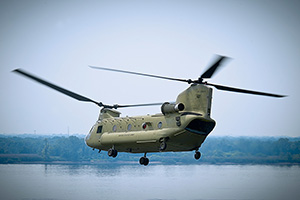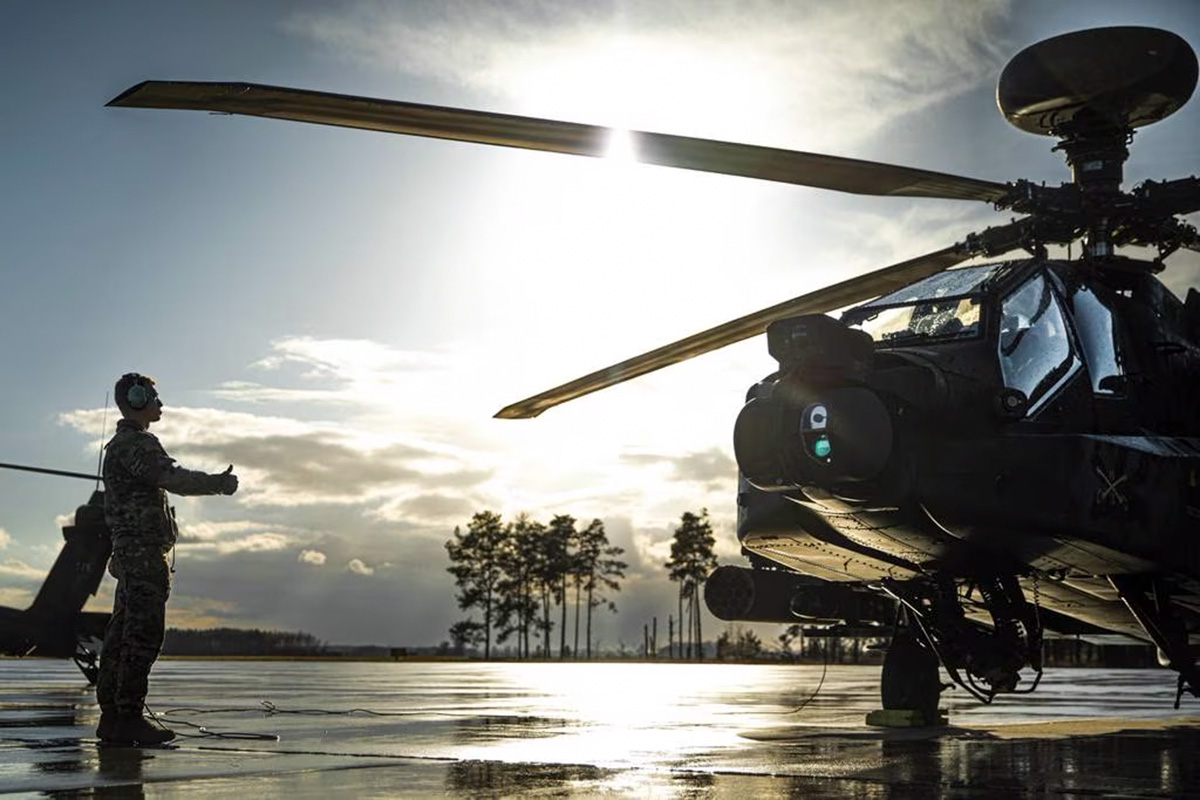
U.S. soldiers participate in a training exercise alongside Polish service members at Powidz, Poland, March 15, 2023. U.S. soldiers participate in a training exercise alongside Polish service members at Powidz, Poland, March 15, 2023. (Sgt. Agustín Montañez/Army)
|

Poland gets green light to buy Apache helicopters

WASHINGTON — The State Department has cleared a sale of 96 AH-64E Apache attack helicopters worth about $12 billion to Poland, the Defense Security Cooperation Agency announced Aug. 21.

The decision comes after the Polish Ministry of National Defense sent a letter of request to the U.S. government nearly a year ago to buy the Boeing-made helicopters for its armed forces.

The helicopters “will first be deployed to the 18th Mechanized Division. Not all of them, but the first units. This is because the 18th Division will be equipped with the Abrams tanks. These helicopters work great with Abrams tank[s],” deputy prime minister and Polish defence minister Mariusz Błaszczak, said in a statement released by the ministry at the time. “Together, they constitute an enormous force, a force of resistance … we want to use them to deter our opponent.”

Jen Judson

Jen Judson is an award-winning journalist covering land warfare for Defense News. She has also worked for Politico and Inside Defense. She holds a Master of Science degree in journalism from Boston University and a Bachelor of Arts degree from Kenyon College.

Similar Posts

  • CH-46 Sea Knight Helicopter – Workhorse of the Navy

    The CH-46 Sea Knight Helicopter has been the workhorse of the Navy and Marine Corps medium-lift squadrons since it entered service in June 1964.  It was developed as the Vertol Model 107, which was also being designed for the civilian market, and was first flown on April 22, 1958.  An initial trial batch was ordered by the Army but this was redued when Vertol published drawings of the enlarged Model 114 which became the Chinook.  By 1960 Vertol had been absorbed into Boeing.

  • |

    That Time Cessna Made a Helicopter

    If you’d like to stump everyone at aviation trivia, simply ask them to name the Cessna with the shortest takeoff-and-landing distances. More than likely, guesses would include the O-1 Birddog and possibly the 180 and 182. However, digging into the dustier corners of Cessna’s history reveals the true winner—its one and only helicopter the company ever produced, the CH-1 Skyhook.

  • US Military Helicopters in Focus

    In the intricate theatre of modern warfare, the US military’s approach to conflict has evolved significantly, particularly within the rugged desert terrains of the Middle East. Central to this evolution are military helicopters, which have seamlessly transitioned from supporting roles to becoming linchpins in war strategy. These formidable flying machines have increasingly been used for vital attack and reconnaissance missions.

    Furthermore, the modern battlescape demands constant adaptation. Consequently, the US military is continuously in pursuit of advanced helicopter designs, encompassing cutting-edge technology to better equip them for their multifaceted roles on the battlefield.

  • Army Helicopter Pilots Are Specially Trained

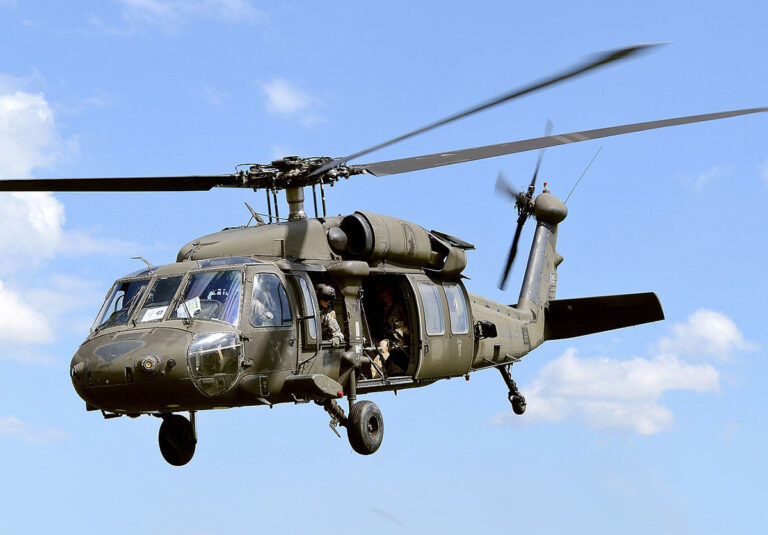
    Army helicopter pilots are specially trained for combat missions and flying in challenging conditions. Becoming an army helicopter pilot must be one of the most exciting careers there is. You could be ferrying troops or ammunition in a Chinook helicopter, scouting in a Kiowa, working special operations in a Black Hawk helicopter, or controlling the…

  • More CH-47 Chinook Helicopter History

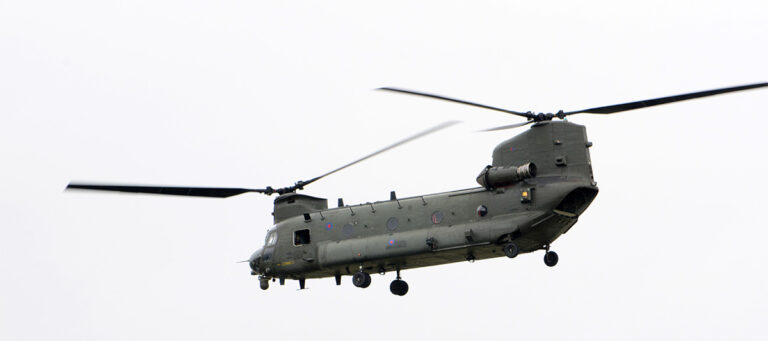
    The Boeing CH-47 Chinook Helicopter has a storied history. Initially developed as an expansion of the Vertol Model 107, it was favored by the Army. Why? Because of its substantial carrying capacity. Its prototype took to the skies on September 21, 1961, and the Army welcomed the CH-47A Chinook in 1972.

    These large twin rotors, combined with a roomy fuselage and cutting-edge turboshaft engines, provided a level of airlift ability previously unseen. Furthermore, the design of the Chinook’s fuselage is primarily free from obstructions, housing the engine and gearbox in pylons and fuel in side pods.

  • |

    Helicopter Dustoffs in Vietnam

    Medevac helicopters revolutionized how wounded soldiers were treated in battle. 29% of all wounded US Soldiers died during World War II. This number was reduced to 26% during the Korean War due to advances in medical technology and the use of medevac helicopters like the Bell 47. This number was further reduced to 19% during the Vietnam War. To put the percentages in to perspective, medevac helicopters in Vietnam transported 400,000 wounded soldiers compared to 17,700 during the Korean War.